Minoan Art Wall Paintings Figurines Vases Etc Reveals the Following
The art of the Minoan civilisation of Bronze Age Crete (2000-1500 BCE) displays a love of brute, sea, and plant life, which was used to decorate frescoes and pottery and besides inspired forms in jewellery, stone vessels, and sculpture. Minoan artists delighted in flowing, naturalistic shapes and designs, and there is a vibrancy in Minoan art which was not present in the contemporary Due east. Bated from its aesthetic qualities, Minoan art also gives valuable insight into the religious, communal, and funeral practices of one of the earliest cultures of the aboriginal Mediterranean.
Inspirations
The Minoans, as a seafaring culture, were in contact with foreign peoples throughout the Aegean, as is evidenced by the Virtually E, Babylonian, and Egyptian influences in their early art but also in trade, notably the substitution of pottery and foodstuffs such as oil and vino in return for precious objects and materials such every bit copper from Cyprus and ivory from Egypt. Thus Minoan artists were constantly exposed to both new ideas and materials which they could utilize in their own unique fine art.
The Minoans, as a seafaring culture, were in contact with foreign peoples throughout the Aegean.
Minoan fine art was not only functional and decorative merely could also have a political purpose, especially the wall paintings of palaces where rulers were depicted in their religious role, which reinforced their role equally the caput of the community. Information technology is likewise important to remember that art objects were largely reserved for the ruling elite, who were in the considerable minority when compared to the residuum of the population who were mostly farmers. Thus, costly art works became a means to emphasise differences in social and political condition for those fortunate enough to own them.
Minoan Pottery
Minoan pottery went through various stages of development, and the start were the pre-palatial style known every bit Vasiliki with surfaces decorated in mottled carmine and black and Barbotine wares with decorative excrescences added to the surface. Adjacent came polychrome Kamares ware. Probably originating from Phaistos and dating from the Old Palace menstruum (2000 BCE - 1700 BCE), its introduction was contemporary with the inflow of the pottery wheel in Crete. The distinctive elements of Kamares pottery are lively red and white designs on a black background. Geometric forms are common but in that location are as well impressionistic fish and polyps as well as abstract human figures. Sometimes, shells and flowers were also added to the vessel in relief. Common forms are beaked jugs, cups, pyxides (small boxes), chalices, and pithoi (very large handmade vases, sometimes over 1.7 m high and used for nutrient storage).
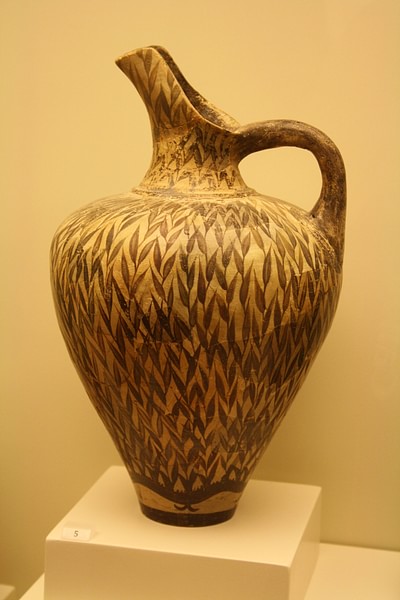
Minoan Jug in Floral Style
The New Palace menstruum (c. 1600 BC to 1450 BCE) saw an evolution in technique and, with it, developments in both form and design, including the production of terra cotta sarcophagi. More than slender vases, tapering at the base became common, and new designs appeared such every bit the stirrup jar with one existent opening and a second false one with 2 handles. Spirals and lines are at present restricted to areas around handles and necks with, instead, plants and marine life taking middle phase. The Floral Style most ordinarily depicts slender branches with leaves and papyrus flowers. Perhaps the most celebrated example of this fashion is the jug from Phaistos which is entirely covered with grass ornament.
The gimmicky Marine Fashion, meanwhile, is characterised by detailed, naturalistic depictions of octopuses, argonauts, starfish, triton shells, sponges, coral, rocks and seaweed. Farther, the Minoans took full advantage of the fluidity of these bounding main creatures to fill and surround the curved surfaces of their pottery. Bull'south heads, double axes, and sacral knots also frequently appeared on pottery, too.
The New Palace Fashion arrives from 1450 BCE. Perhaps influenced by increasing contact with the Mycenaean civilisation from the Greek mainland, typical examples are the iii-handled amphorae, squat alabastron vessels, goblets and ritual vessels with figure-of-eight handles. Wares are decorated with much more schematic and stylised representations than the previous styles, with new designs not seen before including birds, warriors, and shields.
Minoan Stone Vessels
Besides terracotta, the Minoans also made vessels from a broad variety of rock types, laboriously etching the textile out using chisels, hammers, saws, drills and blades. The vessels were finished past grinding with an annoying such as sand or emery imported from Naxos in the Cyclades. Most designs were inspired by contemporary pottery shapes and even pottery decoration such as the Marine Style was transferred to rock vessels.
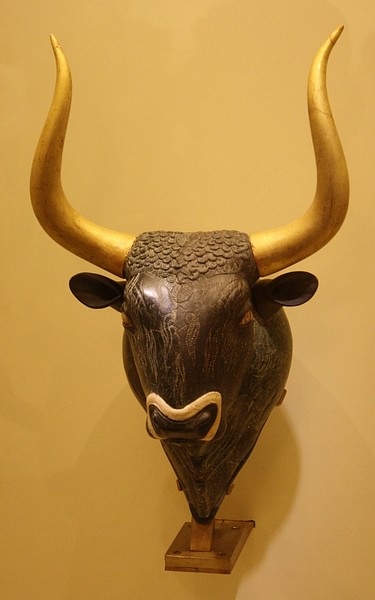
Minoan Rhyton
Popular shapes in stone include the 'bird's nest' lidded bowl which tapered significantly at the base and was probably used to store thick oils and ointments. As artists grew in confidence other, more than ambitious and larger, vessels were made such as ritual vases or rhyta which could take many forms and which were usually covered in gold leaf. Mayhap the most famous case is the serpentine bull's head from the Piddling Palace at Knossos (c. 1600-1500 BCE) which is now in the Archaeological Museum of Heraklion. With golden wooden horns, rock crystal eyes and a white tridacna crush cage the animal is superbly rendered, capturing a life-like pose that would not be equalled in art until Classical Greek sculpture a millennium subsequently.
An ivory leaping figurine is perhaps the earliest known attempt in sculpture to capture free movement in infinite.
Minoan Sculpture
Figure sculpture is a rare observe in the archeology of Crete but plenty small figurines survive to illustrate that Minoan artists were as capable of capturing movement and grace in 3 dimensions as they were in other fine art forms. Early on figurines in clay are less accomplished just show the clothes of the time with men (coloured reddish) wearing belted loin cloths and women (coloured white) in long flowing dresses and open-fronted jackets. There are as well bronze figurines, typically of worshippers only also of animals, especially oxen.
Subsequently works are more sophisticated and amongst the nigh pregnant is a figurine in ivory of a man leaping in the air (over a bull which is a separate figure). The hair would have been added using bronze wire and the clothes in aureate leafage. Dating to 1600-1500 BCE, it is perchance the primeval known attempt in sculpture to capture gratuitous move in space. Some other representative piece is the striking figure of a goddess brandishing a snake in each of her raised easily. Rendered in faience, the figurine dates to around 1600 BCE. Her bare breasts stand for her role as a fertility goddess, and the snakes and true cat on her caput are symbols of her dominion over wild nature. Both figures are in the Archaeological Museum of Heraklion, Crete.
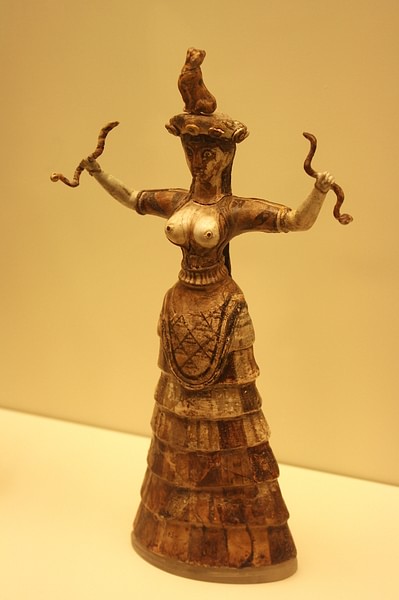
Minoan Snake Goddess, Knossos.
Minoan Frescoes
The Minoans decorated their palaces with true fresco painting (buon fresco), that is, the painting of colour pigments on wet lime plaster without a binding agent and so that when the paint is absorbed by the plaster it is stock-still and protected from fading. Fresco secco, which is the application of pigment, in particular for details, onto a dry plaster was as well used throughout the palaces every bit was the use of depression relief in the plaster to give a shallow iii-dimensional issue. Colours employed were black, crimson, white, yellow, blue, and green. There are no surviving examples of shading effects in Minoan frescoes, although, interestingly, sometimes the colour of the background changes whilst the foreground subjects remain unchanged. Although the Egyptians did not apply true fresco, some of the color conventions of their architectural painting were adopted by the Minoans. Male person pare is ordinarily cherry, female is white, and for metals: gold is yellow, silver is blueish, and bronze is red.
Frescoes busy the walls (either in their entirety or above windows and doors or below the dado), ceilings, wooden beams, and sometimes floors of the palace complexes. They depicted showtime abstract shapes and geometric designs, and so, later, all manner of subjects ranging in scale from miniature to larger-than-life size. Scenes of rituals, processions, festivals, ceremonies, and balderdash sports were well-nigh popular. In one case once again scenes from nature were common, specially of lilies, irises, crocuses, roses, and also plants such as ivy and reeds. Indeed, the Minoans were one of the earliest cultures to paint natural landscapes without any humans present in the scene; such was their admiration of nature. Animals, besides, were oft depicted in their natural habitat, for example, monkeys, birds, dolphins, and fish. Although Minoan frescoes were often framed with decorative borders of geometric designs the principal fresco itself, on occasion, went beyond conventional boundaries such equally corners and covered several walls, surrounding the viewer.

Griffin Fresco, Knossos, Crete
Celebrated examples of Minoan frescoes include two young boxers, young men conveying rhytons in a procession, a group of male and female figures leaping over a balderdash, a large-scale seated griffin against a bold red background, and dolphins swimming above a sea floor of urchins. These tin exist seen at the National Archaeological Museum of Athens, the Archaeological Museum of Heraklion, and in situ (reproductions) at Knossos, Crete.
Minoan Jewellery
Smelting technology in aboriginal Crete immune for the refining of precious metals such equally gold, silver, bronze, and gold-plated bronze. Semi-precious stones were used such as rock crystal, carnelian, garnet, lapis lazuli, obsidian, and ruby, green, and yellow jasper. Amethyst was also pop and was imported from Arab republic of egypt where it was no longer fashionable in jewellery, a fact which illustrates the Minoan independence of mind regarding materials and pattern. Faience, enamel, steatite (soapstone), ivory, beat, glass-paste, and blue frit or Egyptian bluish (a synthetic intermediate betwixt faience and drinking glass) were likewise at the disposal of Minoan jewellers.
Minoan jewellers possessed the total repertoire of metalworking techniques (except enamelling) which transformed precious raw material into a staggering array of objects and designs. The majority of pieces were constructed by hand, merely such items as rings were oftentimes made using three-piece moulds and the lost-wax technique. Beads were sometimes made that mode, too, allowing a certain mass product of these items.
Gold was the most prized textile and was beaten, engraved, embossed, moulded, and punched, sometimes with stamps. Other techniques included dot repoussé, grid (fine gold wire), inlaying, gilded leaf covering and finally, granulation, where tiny spheres of gold were attached to the main piece using a mixture of glue and copper table salt which, when heated, transformed into pure copper, soldering the 2 pieces together.
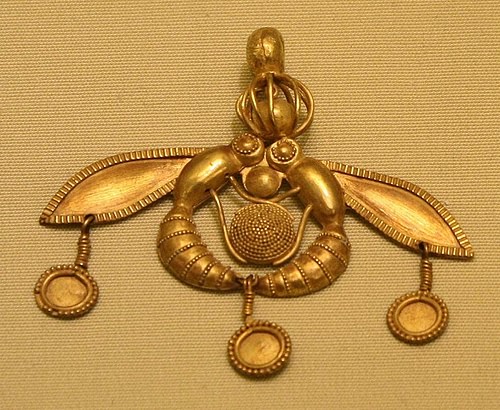
Minoan Bee Pendant
Jewellery took the form of diadems, necklaces, bracelets, chaplet, pendants, armlets, headbands, apparel ornaments, hair pins and pilus ornaments, pectorals, bondage, rings, and earrings. Rings deserve special mention equally they were not only decorative but also used in an administrative capacity as seals. The majority consisted of a slightly convex oval gold bezel at a right angle to a plain hoop, also of gold. Ring bezels were most often engraved with detailed miniature scenes representing hunting, fighting, bull-leaping, goddesses, mythological creatures, and flora and animate being. These miniature masterpieces, like frescoes and pottery decoration, illustrate the Minoan fondness for filling the entire available surface even if figures had to be distorted in order to be accommodated. Another field of the Cretan jeweller and engraver was busy weapons such equally sword blades, hilts and pommels engraved with figures.
Two of the finest Minoan jewellery pieces are pendants, one of a pair of bees and the other showing a effigy holding birds. The onetime was plant at Malia and is in the class of 2 bees (possibly also wasps or hornets) rendered in corking detail and realism, clutching between them a drop of beloved which they are about to eolith into a circular, granulated honeycomb. Above the bees is a spherical grid cage enclosing a solid sphere, and below the pendant hang three cut-out circular disks decorated with filigree and granulation. The second pendant, normally known as the Primary of the Animals pendant, is from Aegina, although enquiry has shown information technology to be of Cretan origin and most probably looted in the Mycenaean menses. The pendant consists of what appears to be a nature god or priest holding the neck of a water bird or goose in each hand and dressed in typical Minoan costume - belt, loincloth, and frontal sheath. 5 disks hang from the base of operations of the pendant.
Legacy
Minoan artists greatly influenced the art of other Mediterranean islands, notably Rhodes and the Cyclades, especially Thera. Minoan artists were themselves employed in Egypt and the Levant to beautify the palaces of rulers at that place. The Minoans as well heavily influenced the art of the subsequent Mycenaean civilization based on mainland Greece. Mycenaean potters, jewellers, and fresco painters, in detail, copied Minoan techniques, forms, and designs, although they did make their marine life, for example, much more abstract, and their art, in general, included many more martial and hunting themes.
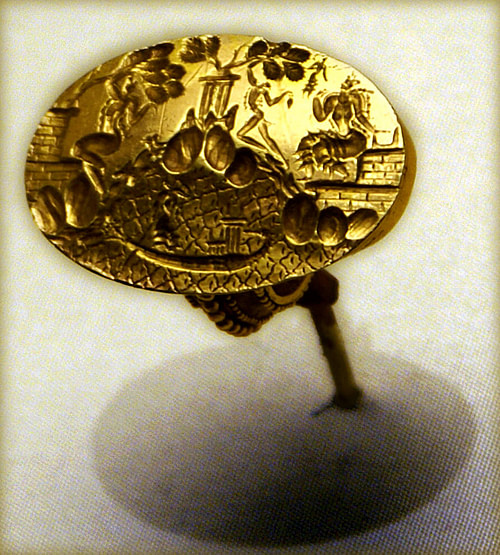
Minoan Gold Ring
As for afterward times in Archaic and Classical Greece, the influence of Minoan and and so Mycenaean art is difficult to trace with concrete examples. The later Greeks were certainly aware of the heritage of their forefathers in the Aegean; tholos tombs and the citadel of Mycenae were never buried from sight, for example. Depictions of double axes (or l abrys) in stone and fresco may have combined to give nascency to the legend of Theseus and the labyrinth-dwelling Minotaur so pop in classical Greek mythology. The lasting legacy of the Minoans, though, is best described here by the art historian R. Higgins:
Mayhap the greatest contribution of the Bronze Historic period to Classical Greece was something less tangible; but quite possibly inherited: an attitude of listen which could infringe the formal and hieratic arts of the East and transform them into something spontaneous and cheerful; a divine discontent which led the Greek ever to develop and improve his inheritance. (Higgins, 190)
This article has been reviewed for accurateness, reliability and adherence to academic standards prior to publication.
Source: https://www.worldhistory.org/Minoan_Art/
0 Response to "Minoan Art Wall Paintings Figurines Vases Etc Reveals the Following"
Publicar un comentario