Why Does the Arab israeli Conflict Continue Toda
For more than 70 years, the Israeli-Palestinian conflict has affected the Middle East landscape. A comprehensive diplomatic solution has defied international efforts, leaving publics disillusioned about the prospect of peace. Large-scale violence ebbs and flows, leaving communities insecure and enabling the conflict to persist as a rallying tool for extremist actors, thereby demanding continued U.S. and international attention.
Yet amid this challenging context lie pockets of potential for advancing a sustainable resolution to the conflict. An established Israeli and Palestinian civil society ecosystem works to advance prospects for a just and lasting peace, and regional geopolitical shifts could offer new openings to forge progress toward Israeli-Palestinian and broader regional conflict resolution.
USIP'S WORK
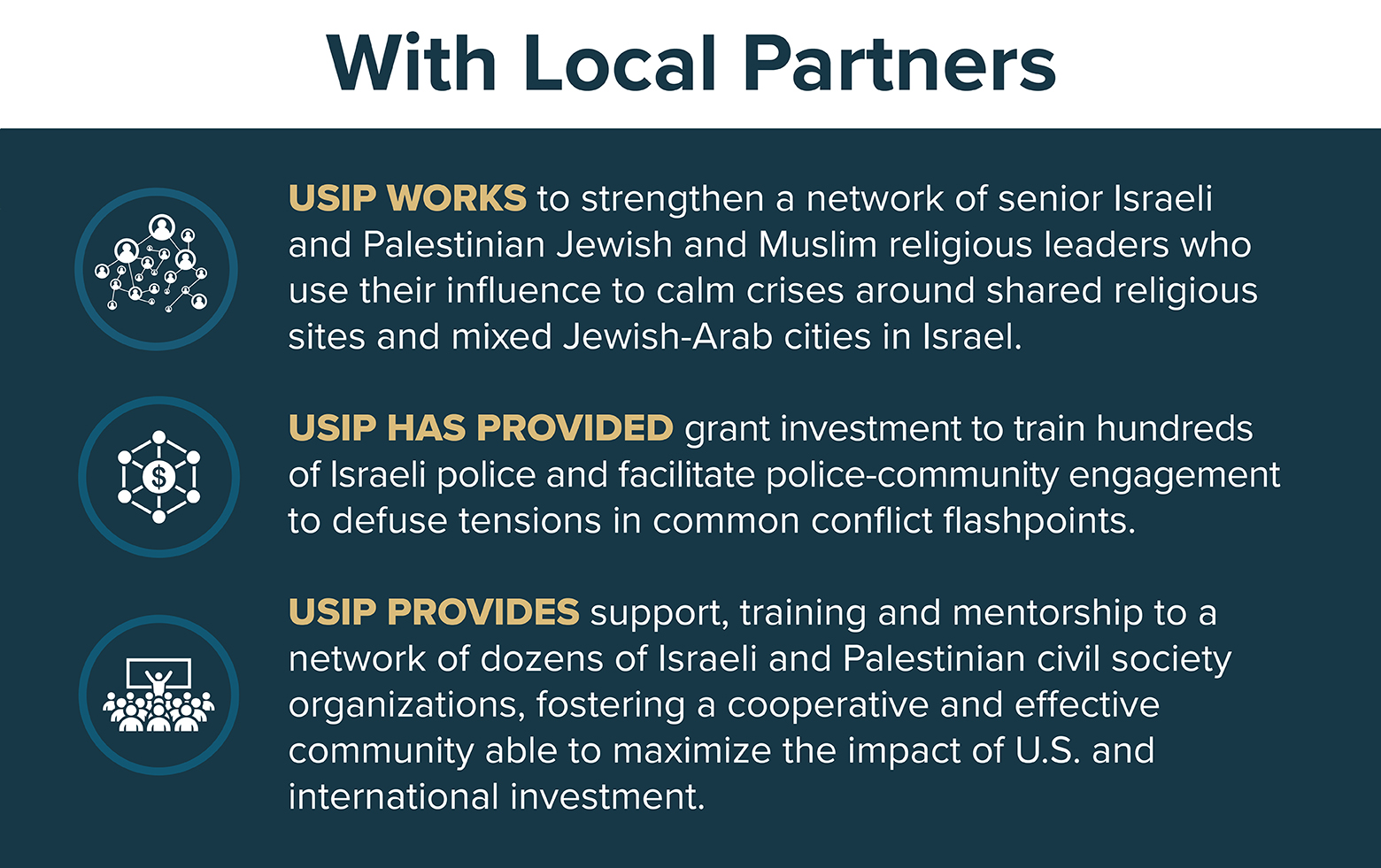
For three decades, USIP has worked on the Israeli-Palestinian conflict and Arab-Israeli relations. Through dialogue, analysis and joint action at the grassroots and policy levels, USIP works to strengthen diplomatic peacemaking efforts; empower Palestinian and Israeli civil society actors working to build trust within and between their societies; enhance community security for Israelis and Palestinians; and build institutional capabilities that prepare the ground for a just, peaceful and sustainable solution to the conflict.
USIP has also supported over 200 grantees and more than two dozen fellows to conduct innovative work on the conflict. Recent work includes:
Convening Experts and Informing Policy
USIP convenes American, Israeli, Palestinian and international experts to jointly develop analysis and actionable recommendations to inform the policy community. As a trusted convener across a spectrum of views, the Institute informs the policymaking process through working groups, analysis and briefings. This work includes:
- The Study Group on Arab-Israeli Peacemaking. Since 2008, the study group has developed a set of best practices for American diplomacy; produced two publications: "Negotiating Arab-Israeli Peace" and "The Peace Puzzle: America's Quest for Arab-Israeli Peace 1989–2011;" and is developing a third volume of lessons learned from American efforts to bring about Israeli-Palestinian peace.
- The initiative on Changing Regional Dynamics and Prospects for Israeli-Palestinian Peace which, in partnership with the Baker Institute for Public Policy at Rice University, convenes American and international experts to evaluate evolving Israeli-regional relations and generate recommendations for leveraging the current context to prevent deterioration and promote progress toward resolving the Israeli-Palestinian and broader Arab-Israeli conflict.
Enhancing Community Security and Institutional Capacity
Through ongoing partnerships with local leaders, U.S. government representatives and the international community, the Institute contributes expertise to building effective Palestinian institutions and enhancing Israeli-Palestinian cooperation that can improve conditions on the ground, build confidence and trust, and ripen conditions for a sustainable diplomatic solution.
In partnership with the Office of the Quartet, USIP mapped police movement and access realities in the West Bank, enabling the most extensive expansion of Palestinian communities' access to their own policing services in 15 years.

Leveraging its expertise, the Institute works closely with senior Palestinian and Israeli security authorities, and the Office of the U.S. Security Coordinator, to ensure coordination that bolsters safety and security for Palestinians and Israelis and enhances rule of law. USIP also works with both sides and international partners to enable a more robust Palestinian economy.
Fostering Religious and Interreligious Peacebuilding Engagement
Faith leaders can be crucial to diplomatic processes, but too often these religious voices have been excluded from Israeli-Palestinian diplomatic and grassroots efforts.
USIP is working to make the peacebuilding process more inclusive and effective by supporting local partners who facilitate dialogue, problem solving and joint action among Israeli and Palestinian religious leaders. The Institute funds and guides work that encourages faith leader cooperation to bridge divides, mitigate violence and provide a model for collaboration that protects holy sites and their visitors.
Bridging Divides, Empowering Peacebuilders
USIP leverages its broad and deep set of relationships to strengthen the capacity of Israeli and Palestinian peacebuilding organizations, serving as a hub for learning, skill-building and strategic connections to build a more resilient and impactful field.
Through grants and trainings, the Institute provides Israeli and Palestinian youth with the resources and skills to engage in constructive dialogue, develop leadership skills, identify shared challenges and design and implement joint action projects that prepare the ground for peace.
Related Publications
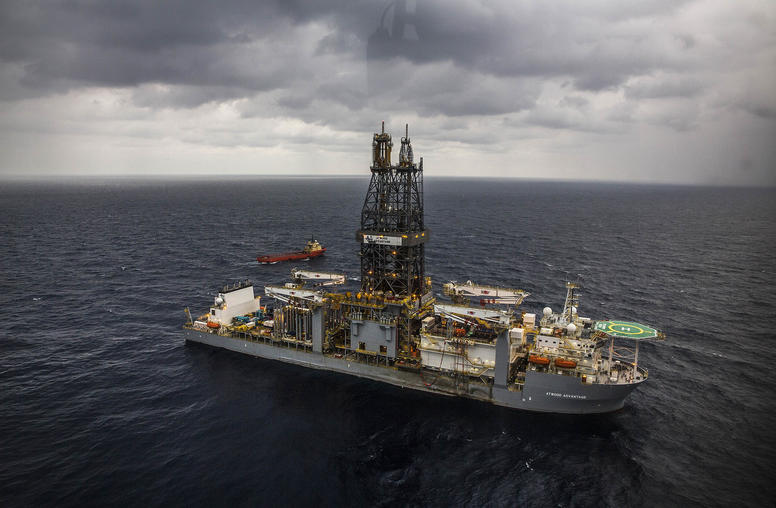
Israel, Lebanon and the United States announced this week that a deal has been reached between Israel and Lebanon on each country's maritime border. Negotiations between the parties over the 330-square-miles of the Mediterranean Sea have proceeded with stops and starts since 2020, but over the past few months edged toward a mutually acceptable outcome. Under the agreement, the contested waters will be divided by a line straddling the "Qana" natural gas field. Both parties would be able to produce gas on their side of the line, in addition to royalty arrangements agreed upon. A buoy line will remain between the two countries.
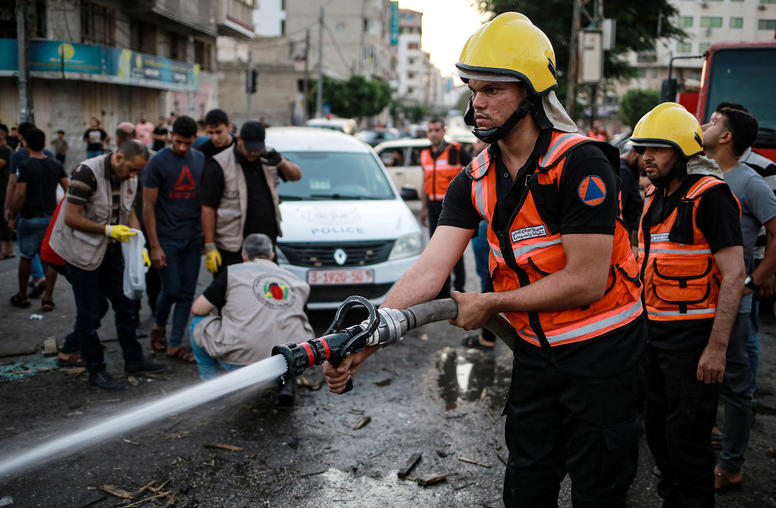
No one was ever in doubt about the damage that the Israeli army can inflict on Gaza, or in the occupied territories in general, in any military confrontation. The gap in the balance of power is one of the widest in the region. This has been the case in the wars that took place in 2008, 2012, 2014, and 2021, and in the latest military attack that ended on August 7, 2022. The duration of the conflict, the extent of the destruction in Gaza, the regional and international response and other factors varied widely. However, unsurprisingly, like in previous confrontations, each side claims that to some extent it was able to achieve its objectives.
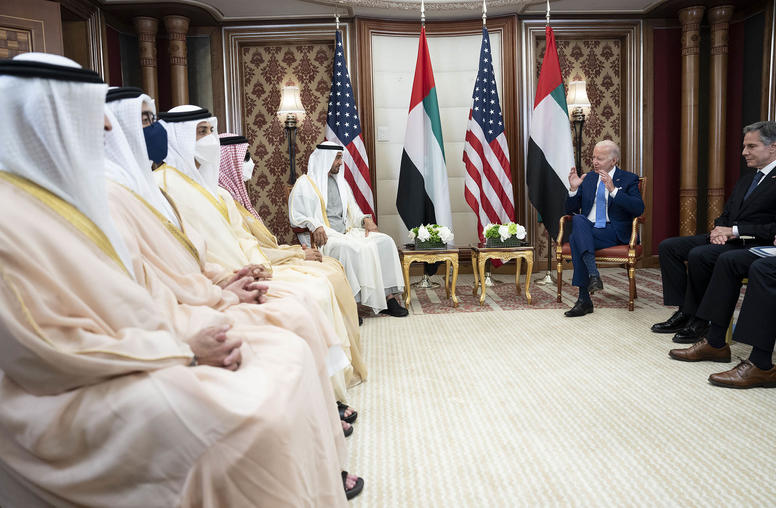
Before and since President Biden took office, debates have proliferated around an American "retrenchment" from the Middle East. The administration has consistently asserted that it is not withdrawing from the region, only aligning strategy and resources — "right-sizing" in the parlance of the moment. Still, most of the region remains unconvinced.
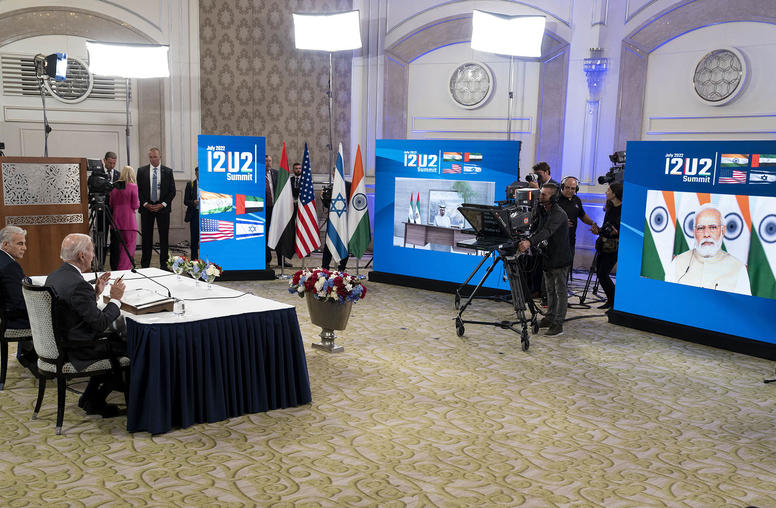
As part of his visit earlier this month to the Middle East, President Biden participated in the first leaders summit of a new grouping made up of Israel, India, the United Arab Emirates and the United States. Known as the I2U2, the countries' foreign ministers formed the bloc in the fall of 2021 to deepen technological and private sector collaboration in the region and tackle transnational challenges in six focus areas: water, energy, transportation, space, health and food security. Beyond the announcement of a food security initiative and a hybrid renewable generation facility for India, little was revealed about what's next for I2U2.
Source: https://www.usip.org/publications/2021/06/current-situation-israel-palestinian-territories-and-arab-israeli-conflict
0 Response to "Why Does the Arab israeli Conflict Continue Toda"
Publicar un comentario